
Print on Demand vs Mass Manufacturing
Why BinMahmood Chose the Slower, Greener Way
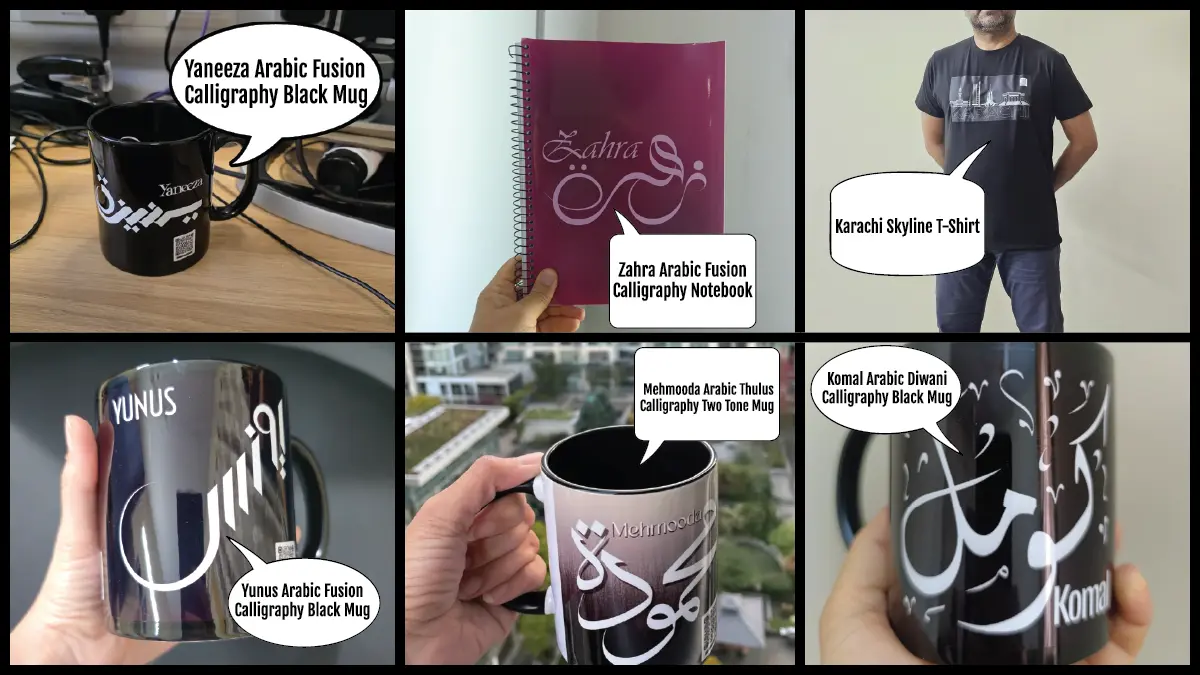
When BinMahmood was founded, two decisions were made that shaped everything that came after. The first was about the art — every piece would be mouse-crafted, never generated. The second was about how that art reaches the person who ordered it — through print-on-demand, not a warehouse full of pre-made stock.
The second decision is less visible than the first. You do not see it in the finished product. But it defines how BinMahmood operates, why every piece is genuinely made for the person who ordered it, and why nothing here sits in a box waiting to be sold to whoever comes along.
Print-on-demand is not a workaround. It is a philosophy. And understanding it helps you understand what you are actually buying.
How Mass Manufacturing Actually Works
In a traditional mass manufacturing model, production runs ahead of orders. A brand estimates how many units of a product it will sell, manufactures that quantity in a factory, ships it to a warehouse, and then tries to sell it down to zero. The economics reward scale — the more units produced in a single run, the lower the cost per unit.
This model has one fundamental flaw: it requires predicting the future. And nobody predicts the future correctly, consistently. The result is overproduction — products that were manufactured, shipped, stored, and never sold. Products that end up in landfills, discount bins, or incinerated to avoid the cost of continued storage.
The fashion and lifestyle products industry is one of the most severe offenders. Printful’s sustainability research documents that the fashion industry alone discards approximately 92 million tons of textiles every year — most of it unsold inventory that was never needed in the first place.
For a personalised calligraphy product, mass manufacturing is not even theoretically possible. You cannot pre-manufacture a mug with Ruqayyah written in Sunbuli script before Ruqayyah has placed an order. The personalisation itself breaks the mass manufacturing model.
How Print-on-Demand Works — and Why It Is Different
Print-on-demand flips the sequence entirely. Nothing is manufactured until an order is confirmed. When you place an order at BinMahmood, that is when your piece enters production — not before.
Your name is composed. The design is finalised. It is sent to the print partner. The product is made. It is shipped to you.
No warehouse. No pre-made stock sitting under fluorescent lights. No version of your piece that was manufactured for nobody in particular and happened to have your name added later. The piece that arrives at your door did not exist before you ordered it.
This has real environmental consequences. Research published by DC Fashion Week found that digital printing technology used in POD conserves up to 95% of water compared to conventional textile dyeing processes. Traditional manufacturing wastes as much as 15% of fabric during the cutting process alone. POD eliminates both.
When nothing is made until it is needed, nothing is wasted. That is not an environmental slogan. It is the arithmetic of how the model works.
The Honest Comparison
| Comparison | Mass Manufacturing | Print on Demand (BinMahmood) |
|---|---|---|
| Purpose | Produced before any order exists | Produced only after your order is confirmed |
| Inventory | Requires demand forecasting | No forecasting needed — demand drives production |
| Storage | Warehouse storage required | No warehouse, no storage costs |
| Waste | Unsold stock goes to landfill | Zero unsold stock — nothing pre-exists your order |
| Scale | Identical products in bulk | Every piece personalised for the buyer |
| Environment | Heavy water and textile waste | Up to 95% less water, minimal textile waste |
| Final Result | Generic — fits whoever buys it | Specific — made for the person who ordered it |
What This Means for Your Order Specifically
When you order a personalised calligraphy mug or a name calligraphy notebook from BinMahmood, two things are happening simultaneously that a mass manufacturer could never replicate.
First, your name is being composed as a calligraphic piece — drawn specifically for your name’s letterforms, in a script chosen for how those letters interact. Second, the product itself is being manufactured for the first time, for you, in this moment.
Nothing about your order is retrieved from a shelf. Nothing was sitting in a box with your name already on it. The entire chain — from design to production to delivery — begins when you place your order.
This is also why delivery takes a little longer than buying something off a warehouse shelf. A piece cannot be at your door tomorrow if it did not exist yesterday. That is not a limitation of BinMahmood — it is proof of what the product actually is.
The Slower Way Is the Right Way
There is a version of this business that would be faster and cheaper to run. Pre-manufacture a hundred generic mugs with popular names, stack them in storage, and ship same-day when orders come in. Many sellers operate exactly this way.
BinMahmood chose not to. Not because of a romantic attachment to slow production, but because pre-manufactured generic products are the opposite of what this studio exists to make. A tote bag with your name in Nastaliq calligraphy, drawn specifically for the rhythm of your name’s letterforms, cannot be pre-manufactured. It does not exist until it is made for you. And making it for you is the whole point.
The wall art on your wall and the mobile cover in your hand were not pulled from a warehouse. They were made. For you. Once. That is what print-on-demand makes possible — and it is why BinMahmood will not operate any other way.
Zero waste. Zero pre-made stock. One order. One piece. Made for the person whose name is on it.
The Bigger Picture
Pakistan, Bangladesh, Malaysia, and Indonesia — the core markets BinMahmood serves — are among the countries most exposed to the downstream consequences of fast fashion and mass overproduction. Textile waste from global brands ends up in South and Southeast Asian landfills and waterways at a disproportionate rate. Choosing print-on-demand is not a solution to that problem at scale, but it is a refusal to contribute to it.
Every order placed at BinMahmood produces exactly one product. No excess. No waste. No version of your piece that was made for someone else and never sold.
That is the model. And it is not going to change.
Read more about the craft and values behind BinMahmood in Personalized vs Mass Produced and Mouse-Crafted vs AI Generated on the blog, or explore the full story on the BinMahmood international blog.
Every piece made for you. Only for you. At binmahmood.pk
Mugs · Notebooks · Wall Art · Tote Bags · Mobile Covers
Mouse-crafted, never generated. Made on demand, never in advance.