Personalized vs Mass Produced
Your Name Is Not a Template: What Personalisation Actually Means in Arabic Calligraphy
You have seen it. A mug, a notebook, a tote bag — your name on it, written in what looks like a decorative script, sitting against a floral background. It arrives quickly. It costs very little. And from a distance, it looks personalised.
But here is the question worth asking: what actually happened to your name?
In most cases, the answer is this — someone typed your name into a text field. A system selected a font. A pre-built background was placed behind it. Your name filled a slot that any other name could fill just as easily. Nothing about that product was made for you. It was made with your name as an input.
That is not personalisation. That is a template with a variable.
The Template Problem
Templates are not inherently bad. They are efficient. They are consistent. They allow thousands of products to be produced quickly and affordably — and for many things in life, that is exactly what you want.
But calligraphy is not one of those things.
Arabic calligraphy — real calligraphy, whether classical or contemporary fusion — has never been a template art. For over a thousand years, every name, every phrase, every inscription was a fresh act of composition. As the Metropolitan Museum of Art explains, calligraphy appears on virtually every medium across Islamic art — from architecture to ceramics to metalwork — precisely because it is an art of intentional decisions, not repetition.
A master calligrapher did not reach for a stamp. They looked at the specific letters in front of them and made decisions. How does this Meem sit beside this Ha? Does this Alif need to breathe, or does it anchor the composition? Where does the eye need to rest?
A template makes those decisions before your name arrives — which means it makes them well for none.
What BinMahmood Actually Does
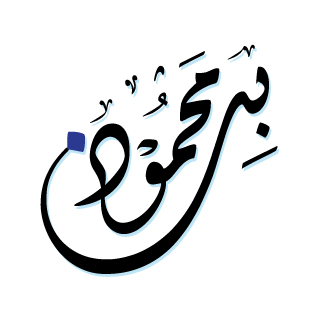
Every name that comes through BinMahmood starts with a blank canvas in Adobe Illustrator.
Not a pre-built file with a name-shaped hole in it. A blank canvas.
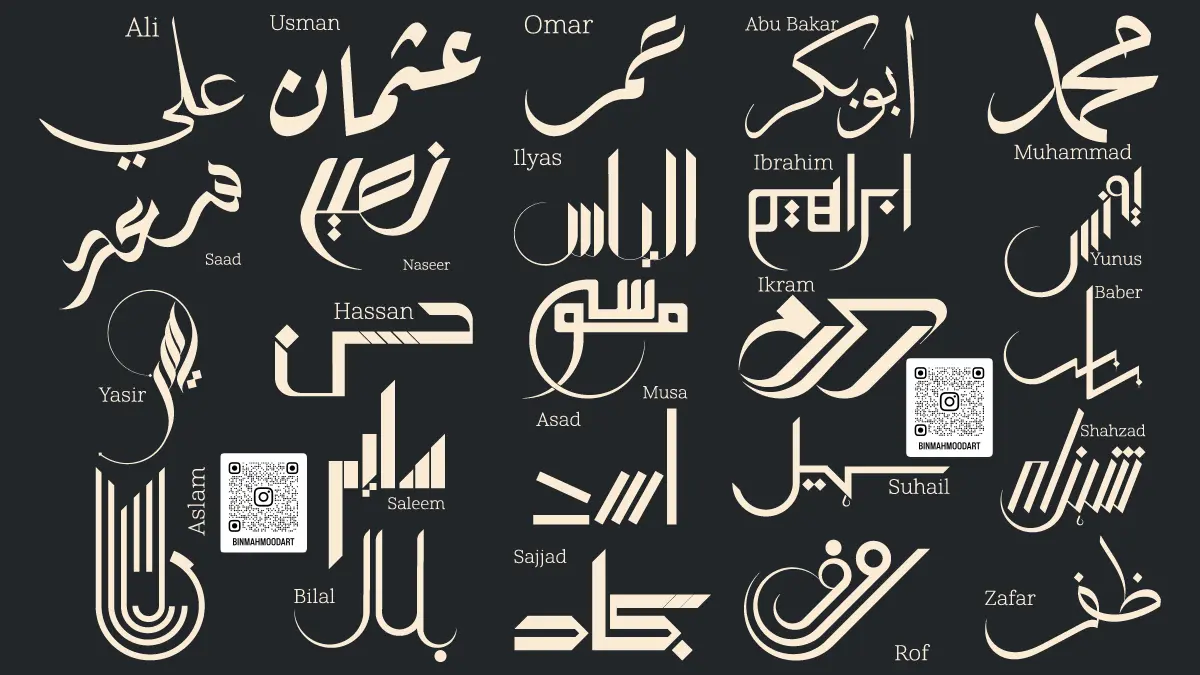
The script style is chosen based on the name itself — its length, the specific Arabic letterforms it contains, the visual rhythm it naturally carries. Hira and Misbah are both beautiful names. They are not interchangeable compositions.
Then the letters are drawn. Not typed. Not selected from a glyph library. Drawn — point by point, curve by curve, using a mouse on a desktop, in Adobe Illustrator. Every anchor point placed with intention. Every curve adjusted until the letterform is mathematically correct and visually alive.
This is why no two BinMahmood pieces look identical — even when they share the same script style. Because no two names are identical compositions.
You can see this in practice across our personalised mugs, our name calligraphy notebooks, our tote bags, and our mobile covers — each piece a composition built from a blank canvas, never from a template.
Side by Side: The Real Difference
| Mass-Market Personalised | BinMahmood Personalised |
|---|---|
| Your name typed into a text field | Your name opens a blank canvas |
| A font selected automatically | A script chosen for your specific letterforms |
| Pre-built background applied | Composition built around your name |
| Letters identical for every name | Letters drawn for your name only |
| Produced in seconds | Crafted with intention and precision |
| Your name filled a slot | Your name began a composition |
| Anyone’s name fits the same template | No two compositions are the same |
The Difference You Can See
Pick up a mass-market personalised product and look at the letters closely. Then ask yourself: would these letters look exactly the same if a different name were placed here? If the answer is yes — if the letterforms are identical regardless of what name fills them — you are looking at a font, not calligraphy.
Now look at a name rendered in true fusion calligraphy. The letters interact. The spacing between them is not mechanical — it breathes. The weight of a stroke shifts slightly depending on what comes before and after it.
That difference is not decoration. It is the difference between a name that was processed and a name that was considered.
Why This Matters More Than It Might Seem
A personalised gift carries a specific promise: I chose something for you specifically.
When that promise is delivered through a template, the recipient — consciously or not — feels the gap. The object looks personal. But it does not feel personal, because nothing about it required anyone to think about them in particular.
This is worth understanding in its full cultural context. In 2021, UNESCO formally recognised Arabic calligraphy as an Intangible Cultural Heritage of Humanity — precisely because what is being preserved is not just a visual style, but the knowledge, the skills, and the human decision-making process behind each piece. A template preserves none of that. A genuinely crafted composition carries all of it.
This is why personalised calligraphy has been a meaningful gift tradition across Pakistani, Bangladeshi, Malaysian, and Indonesian cultures for generations. Not because it has a name on it. Because it required someone to care about that name.
Mass Production Made Things Available. Personalisation Makes Things Meaningful.
These are not competing ideas. Mass production democratised access to goods that were once only available to the wealthy — and there is nothing wrong with that. A notebook from a mass-market store does its job. It holds your writing. It does not pretend to be more.
The problem arises when mass-production logic is applied to something that is being sold as personalised — when a template is dressed up as a considered, crafted object. When the word “personalised” appears on a product, it carries a promise. That promise deserves to mean something.
At BinMahmood, personalisation is where the work begins. Your name arrives. A canvas opens. Decisions are made. That is as true for a personalised mug as it is for a wall art piece — the size of the product changes, the process does not.
One Name. One Composition. One Piece.
There is a reason BinMahmood describes this work as mouse-crafted, never generated. It is not a marketing phrase. It is a description of what literally happens every single time.
No AI. No font. No template. No stock background pulled from a library and placed behind a text field.
A mouse. A canvas. Your name. And the same obsession with getting every stroke right that classical calligraphers brought to their reed pens — just on a desktop, in the digital age, for the wall of your home and the mug on your desk.
Your name is not a variable. It is not a template input. It is the starting point of a composition made entirely for you. That is what personalisation means.
For more on the art behind the work, read more on the BinMahmood blog — or explore what personalised fusion calligraphy looks like across our full collection.
Explore personalised fusion calligraphy at binmahmood.pk
Mugs · Notebooks · Wall Art · Tote Bags · Mobile Covers
Every piece mouse-crafted, never generated.