Mouse-Crafted vs AI Generated
Why the Tool Behind the Art Still Matters
Every week, someone discovers an AI tool that claims to generate Arabic calligraphy. They type a name, hit generate, and receive something that — from a distance, on a small screen — looks like calligraphy. Curves. Strokes. Something vaguely Arabic in its appearance.
Then they look closer.
The letters do not connect the way Arabic letters should. The proportions are off. The visual rhythm that makes a calligraphic composition feel alive — the sense that a human made decisions about every curve — is absent. What they are looking at is not calligraphy. It is a pattern that resembles calligraphy the way a photograph of a painting resembles the painting.
This is not a criticism of AI. It is simply where the technology stands today — and understanding why tells you everything about what makes genuine calligraphy worth seeking out.
Why AI Struggles with Arabic Calligraphy Specifically
AI tools have made remarkable progress in generating images, writing text, and mimicking many visual styles. Arabic calligraphy, however, presents a unique and documented challenge that current models have not solved.
The reason comes down to what Arabic calligraphy actually is. As researchers at IEEE have formally documented, Arabic calligraphy is a two-dimensional art form — letters and words interweave in space, overlap, and stack in ways that standard printed Arabic does not. Reading and generating it is a fundamentally harder problem for AI than generating any standard left-to-right text.
Add to this the proportional system at the heart of classical scripts — the rhombic dot system where every letter’s height, width, and curvature is calculated relative to a single unit — and the challenge multiplies. An AI generating a name in Diwani script is not working from an understanding of those proportional rules. It is interpolating from visual examples in its training data, producing something that looks approximately right to someone who cannot read Arabic calligraphy carefully.
The Communications of the ACM — the world’s most respected computer science publication — noted in 2025 that most AI training datasets are western-centric, limiting models’ ability to interpret Arabic-specific visual content including traditional calligraphy. The data problem compounds the technical problem.
And this is before we even get to personalised name calligraphy — where the AI would need to understand not just script rules in general, but how a specific name’s letterforms interact with each other in a specific composition. That is a problem current models are nowhere near solving reliably.
AI cannot yet generate calligraphy. It can generate something that looks like calligraphy to someone who does not know what calligraphy actually looks like. That is a meaningful distinction.
The English Typography Problem — and Why It Matters Here
Here is a useful benchmark. Ask any current AI image generation tool to render a simple English sentence inside an image. In most cases you will get garbled letters, misspelled words, and characters that merge into each other incorrectly. English — the most heavily represented language in every major AI training dataset on the planet — still trips up image generation models regularly.
Arabic is far more complex than English typographically. It is written right to left. Letters change form depending on their position in a word. Connected scripts require understanding of how one letter’s exit stroke becomes the next letter’s entry stroke. Calligraphic styles add a further layer of proportional and compositional rules on top of that.
If AI still stumbles on English typography in images — a known, widely documented limitation — the distance to reliable Arabic calligraphy generation is not a short step. It is a different category of problem entirely.
This will improve. Technology always does. But how long that improvement takes, and whether it will ever reach the standard of a human calligrapher making real decisions about a real name, is genuinely unknown. What is known is where things stand today.
What Mouse-Crafted Actually Means at BinMahmood
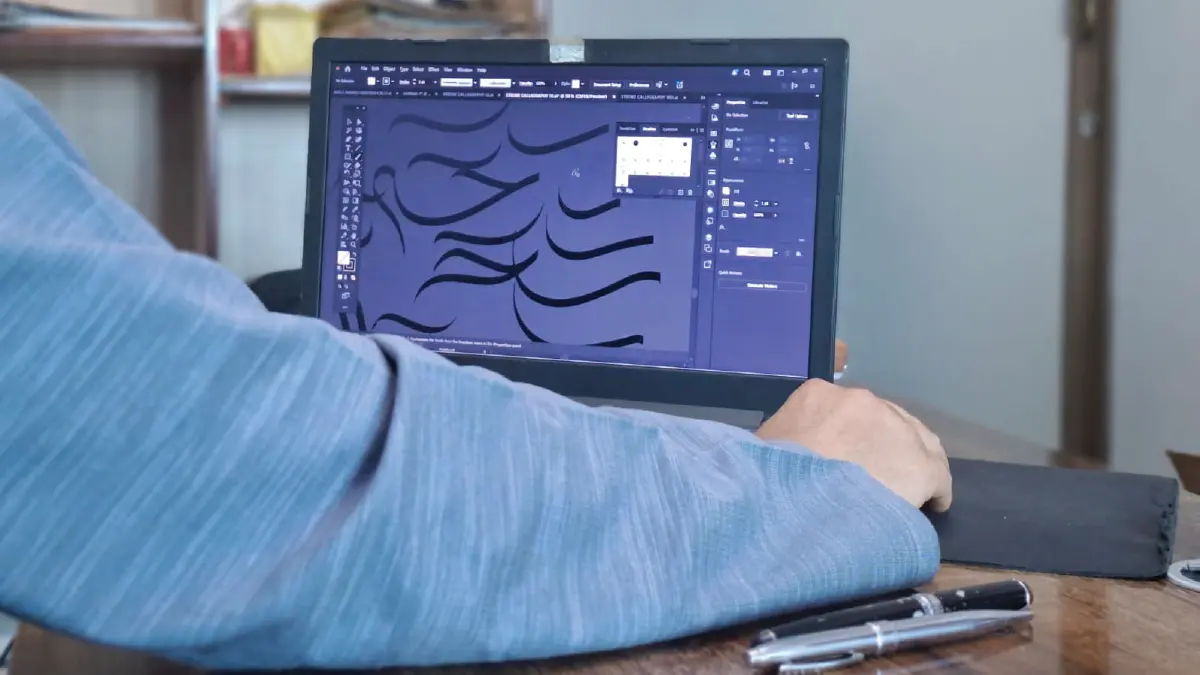
At BinMahmood, every piece starts with a blank canvas in Adobe Illustrator and a mouse.
No AI generation. No font rendering. No template with a name dropped into a pre-built slot. The name arrives, and a decision-making process begins — which script fits this name’s letterforms, how do these specific letters interact with each other at this size, where does the visual weight of the composition need to sit.
Then the letters are drawn. Point by point. Curve by curve. Each anchor node in Illustrator placed deliberately. Each curve adjusted until it matches the proportional logic of the chosen script — Al Wissam, Sunbuli, Diwani, or Nastaliq — as it applies to this specific name.
This is what UNESCO recognised when it listed Arabic calligraphy as an Intangible Cultural Heritage of Humanity in 2021. Not just the visual output — the knowledge, the skills, and the human decision-making process behind each piece. A font or an AI output carries none of that. A mouse-crafted composition carries all of it.
The mouse replaces the reed pen. The intentionality does not change.
The Honest Comparison
| AI Generated “Calligraphy” | BinMahmood Mouse-Crafted |
|---|---|
| Interpolated from training data patterns | Drawn from script proportional rules |
| Letters may not connect correctly | Every connection is deliberate |
| Same output for any name in that “style” | Different decisions for every name |
| No understanding of letterform interaction | Each name’s letters composed together |
| Generated in seconds | Crafted with precision and intent |
| The name was an input | The name was the starting point |
| May improve in the future | Human decision-making, right now |
A Note on the Future of AI in Calligraphy
It is worth saying clearly: AI improving in this space is not something to fear. If future models develop a genuine understanding of Arabic script proportional systems and letterform interaction, that would be a remarkable technical achievement — and it would serve the broader goal of preserving and spreading a tradition that UNESCO considers among humanity’s most precious cultural practices.
But that is not where things are today. Today, what is sold as “AI-generated Arabic calligraphy” is largely a visual approximation — good enough to pass a quick glance, not good enough to hold up as genuine calligraphy to anyone who understands the art form.
BinMahmood’s position is not anti-AI. It is pro-honesty. A mouse-crafted composition is described as mouse-crafted. An AI output should be described as what it is. The customer buying a personalised gift for someone they care about deserves to know the difference.
What This Means When You Buy
When you order a personalised calligraphy mug, a name calligraphy notebook, a tote bag, or any piece from BinMahmood, you are not receiving a generated output. You are receiving a composition that was built for your name specifically — drawn with a mouse, in Adobe Illustrator, by a human who made decisions about your name that no current AI model is capable of making reliably.
That is not a marketing claim. It is a description of the process, and it is verifiable in every curve of every piece.
No AI. No font. No template. A mouse, a canvas, and your name — treated with the same intentionality that classical calligraphers brought to every stroke they ever made.
For more on the craft behind BinMahmood’s work, read about Classical Calligraphy vs Fusion Calligraphy and Personalized vs Mass Produced on the blog — or explore the full approach on the BinMahmood international blog.
Explore mouse-crafted fusion calligraphy at binmahmood.pk
Mugs · Notebooks · Wall Art · Tote Bags · Mobile Covers
Every piece mouse-crafted, never generated.