Classical Calligraphy vs Fusion Calligraphy: One Art Form
What separates a centuries-old discipline from a contemporary art form — and why both matter
There is a moment — if you have ever stood in front of the Badshahi Mosque in Lahore or run your eyes across the tilework of a centuries-old Persian manuscript — where you feel something you cannot quite name. It is not just beauty. It is weight. History. Intention.
That feeling is classical calligraphy doing what it has always done.
But here is the question nobody really asks: what happens to that feeling when it meets the world you actually live in — your desk, your coffee mug, your morning routine?
That is where fusion calligraphy begins.
What Classical Calligraphy Actually Is
Classical Arabic calligraphy is not simply a style of writing. It is a discipline. A science. A spiritual practice that took masters — called khattats — decades to even approach. As the Asian Art Museum notes, the Arabic saying ‘Purity of writing is purity of the soul’ vividly describes the status the master calligrapher held in Islamic society.
Every classical script is governed by a unit of measurement called the rhombic dot — a diamond shape made by pressing the reed pen at a 45-degree angle. From this single dot, every letter proportion is calculated. The height of an Alif. The curve of a Nun. The sweep of a Kaf. Nothing is arbitrary. Nothing is decorative for decoration’s sake alone.
The major classical scripts each have their own character:
Thuluth
Grand, vertical, architectural. The script of mosque facades and Quranic manuscripts. Every stroke feels like it carries the weight of the building it decorates.
Naskh
The workhorse of the classical world. Clean, readable, precise. The script that carried Islamic scholarship across continents because a scholar could write it quickly and a reader could follow it clearly.
Nastaliq
The soul of Urdu and Persian poetry. It moves diagonally, like a sentence mid-thought, like a ghazal mid-breath. No other script captures the lyrical quality of the Subcontinent’s literary tradition quite like Nastaliq does.
Kufic
The oldest. Angular, geometric, almost architectural in its rigidity. The earliest Qurans were written in Kufic. It carries a severity and stillness that later scripts consciously moved away from — but never forgot.
Diwani
The Ottoman court’s gift to calligraphy. Fluid, sweeping, almost secret. It was deliberately complex so documents written in it could not be easily forged.
Each of these scripts took a classical master years — sometimes an entire lifetime — to learn. The Metropolitan Museum of Art describes this perfectly: each letter and diacritical mark is the result of painstaking measurements and multiple strokes — what appears effortless is anything but.
So extraordinary, in fact, that in 2021, UNESCO formally recognised Arabic calligraphy as an Intangible Cultural Heritage of Humanity — a designation shared by only the most precious cultural practices on earth.
So What Is Fusion Calligraphy?
Fusion calligraphy does not replace classical calligraphy. It would not even want to.
What it does is ask a different question: how does this ancient art form live inside a contemporary life?
At BinMahmood, this question is where everything starts.
The frustration that founded this studio was simple: beautiful Arabic calligraphy existed for centuries, but nothing felt personal anymore. Everything was mass-printed, templated, and forgettable. The classical scripts were still magnificent — but they were living in mosques and museums, not in the spaces where people actually spend their days.
Fusion calligraphy is the answer to that gap.
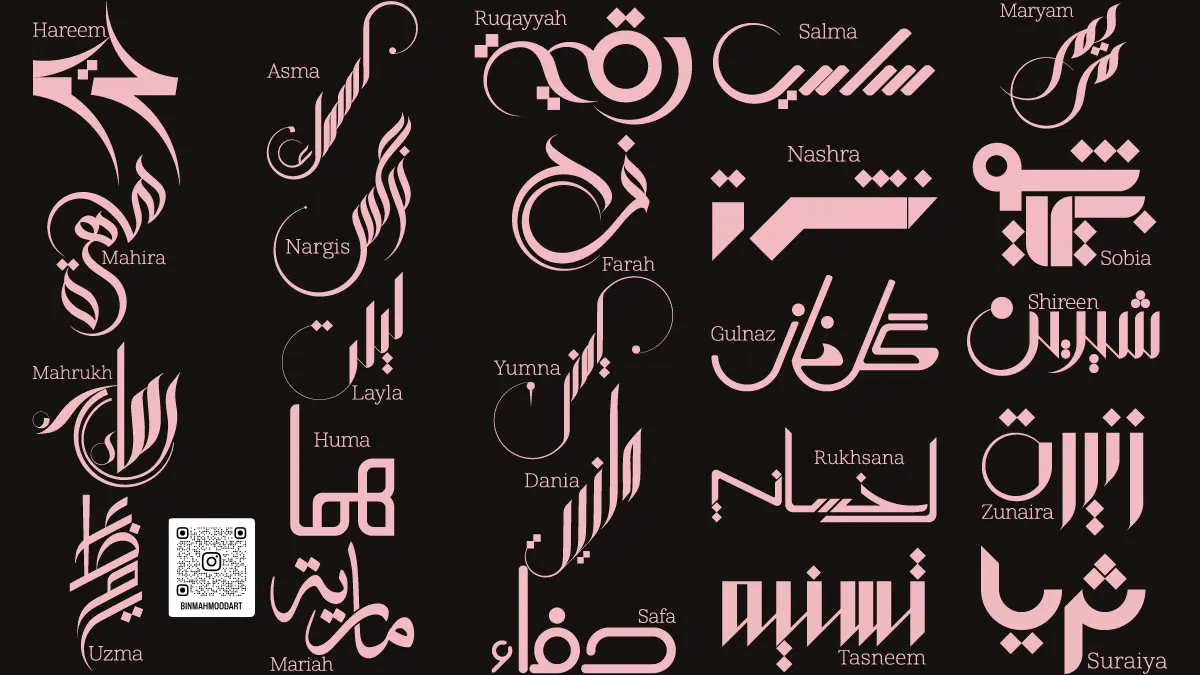
It takes the structural logic of classical scripts — the proportional systems, the letterform heritage, the visual grammar that makes Arabic calligraphy immediately recognisable — and brings it into contact with contemporary design. Clean layouts. Modern colour. Products that people actually use and live with.
At BinMahmood, that means working across three script traditions simultaneously:
- Arabic structure — the geometric precision of scripts like Thuluth and Al Wissam
- Urdu elegance — the flowing diagonals of Nastaliq, the script of South Asian Muslim literary identity
- Persian flair — the ornate curvature of scripts like Sunbuli and the Persian Naskh tradition
And then building something new from all three — on mugs, notebooks, wall art, tote bags, and mobile covers designed to carry this tradition into everyday life.
Mouse-Crafted: What That Actually Means
In 2026, it is genuinely easy to open an AI tool, type a name in Arabic, choose a “calligraphy font,” and put it on a mug. Thousands of sellers are doing exactly that. The result looks like calligraphy from a distance. Up close, it is a font. Every letter is identical regardless of what surrounds it. There is no understanding of how letterforms interact — no human decision-making at all.
Every piece at BinMahmood is mouse-crafted — drawn letter by letter on a digital canvas in Adobe Illustrator, with each curve calculated for mathematical precision. When your name is rendered in Diwani script, the letters are not pulled from a library. They are drawn, adjusted, spaced, and refined specifically for your name — because Ahmad and Aisha require different decisions even within the same script style.
The mouse replaces the pen. The precision does not change.
Classical vs Fusion: Side by Side
| Comparison | Classical Calligraphy | Fusion Calligraphy |
|---|---|---|
| Purpose | Sacred texts, architectural inscription, court documents | Personalised lifestyle products, contemporary art |
| Medium | Reed pen, ink, parchment | Vector tools, digital canvas, print-on-demand |
| Rules | Strict proportional systems, centuries-old | Classical proportions as foundation, modern design applied |
| Personalisation | Rare — the text was usually fixed | Central — your name, your piece |
| Where you find it | Mosques, museums, manuscripts | Your desk, your kitchen, your wall |
| Time to create | Years of mastery | Hours of precision digital craftsmanship |
Neither row is better than the other. They are answering different questions for different moments in a person’s relationship with this art form.
Why This Distinction Matters for You
A classical calligrapher’s work belongs in a frame, handled with care, treated as a piece of heritage. It is extraordinary — and it is also priced accordingly, and rarely available personalised.
A fusion calligraphy piece from BinMahmood is designed to be lived with. Drunk from every morning. Carried to a university library. Hung on the wall of a Karachi apartment or a Kuala Lumpur study. It carries the visual weight of a tradition that is centuries old, but it fits into a life that is happening right now.
The soul of classical calligraphy — the intentionality, the mathematical precision, the reverence for the letterform — did not disappear. It just moved into a different room.
The Scripts BinMahmood Works In
Al Wissam
A contemporary Arabic script with strong classical roots in Naskh. Clear, precise, and remarkably readable even when rendered small. Ideal for names that need to carry both dignity and warmth. See it on our personalised mugs.
Sunbuli
A flowing script with Persian influences, characterised by organic curves and a slightly informal warmth. Where Al Wissam feels structured, Sunbuli feels like a conversation. Explore it across our notebook collection.
Diwani
The classical Ottoman court script, adapted for personalised work. Its sweeping, interconnected forms make a single name feel like a complete composition.
Nastaliq
The heartbeat of Urdu calligraphy. Used selectively for names rooted in the Urdu literary tradition. When a name in Nastaliq is right, nothing else comes close.
Each script is chosen based on the name itself — its length, its letterforms, its rhythm. A design decision made for your specific piece.
A Final Thought
Classical calligraphy spent centuries proving that beauty and precision are not opposites — that the most constrained art forms can produce the most profound results.
Fusion calligraphy is not trying to improve on that. It is trying to carry that same conviction into places where people actually live.
Your name, rendered with that kind of care, on something you use every day — that is what BinMahmood is for.
For more on the world of calligraphy and the stories behind our work, visit the BinMahmood blog.
Explore personalised fusion calligraphy at binmahmood.pk
Mugs · Notebooks · Wall Art · Tote Bags · Mobile Covers
Every piece mouse-crafted, never generated.